


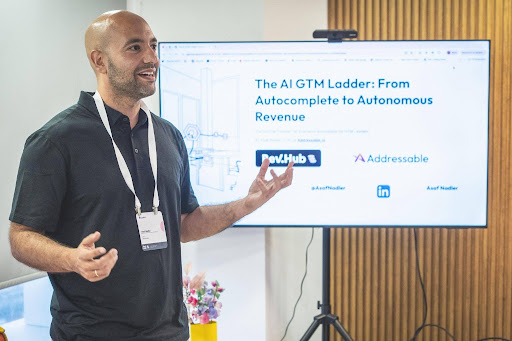
Here's what came out of each table:
TABLE 1 — Pricing in the Age of AI
Facilitated by Bar Potash, Co-Founder @ NextGen-Ops
The question: how do you price when AI rewrites all the rules?
I expected most companies to still be on Per-Seat. I was wrong — half the room had already moved to Consumption or Hybrid models. The shift is happening faster than the market narrative suggests.
The most honest moment of the night came from someone sitting on millions in ARR: "The answer is — we don't know."
Three takeaways:
- It's not the model that changed — it's the cost. When your AI infrastructure is eating your margins, the entire Consumption Pricing equation flips.
- Hybrid pricing was born from pressure, not strategy. Base + variable on top is a bridge between the predictable ARR world and a market demanding flexibility. It works — but it's not a destination.
- Seat-based models are under threat. Salesforce's "Headless" direction signals a future where agents talk to agents — and there are no seats to sell. What will matter instead: Cost Efficiency, Outcome Delivery, and Data Quality.
TABLE 2 — Prospecting in the Era of Signals & AI
Facilitated by Udi Cohen, Director of RevOps @ Lusha
What every leader at the table agreed on:
- AI is not magic. Treating it like a silver bullet is the fastest path to failed implementation.
- The basics still win. Strong infrastructure and clear processes aren't optional — they're the foundation everything else is built on.
- Signals and AI unlock powerful capabilities, but context is everything. You still need to test, learn, and adapt.
The uncomfortable truth: AI is making outbound faster and cheaper — for everyone. Including your competitors.
TABLE 3 — Will Humans Ever Be Replaced in Enterprise Sales?
Facilitated by Gilad Komorov, 3X CRO & GTM Advisor
The consensus was clear: many repeatable, process-oriented tasks can — and should — be handed to AI agents.
- → Lead research
- → Outbound sequencing
- → RFP completion
- → Technical demos
One participant described watching a sophisticated AI sales engineering agent operate alongside an AE in real time. That's not the future. That's now.
But the critical human elements remain non-negotiable:
- → High-stakes negotiations
- → Executive alignment
- → Confidence building
- → Navigating complex org dynamics
The emerging distinction: transactional sales of commoditized products will increasingly be AI-driven. Strategic, high-touch enterprise deals? Still human — for now.
The forward-looking scenario: as AI advances toward AGI, buyer organizations will deploy autonomous procurement agents. AI may ultimately sell directly to buyer agents.
"The question isn't whether AI will replace humans in sales. It's which parts of the sales motion are truly human — and which ones were always just process waiting to be automated." — Gilad Komorov, after 23+ years in enterprise sales
TABLE 4 — How AI-Native Is Your GTM, Really?
Facilitated by Asaf Nadler, Co-Founder & COO @ Addressable.io
Every GTM leader on LinkedIn claims to be "100% AI-native." Most aren't.
The pattern: leaders start as AEs, climb the ladder dreaming of strategic work, and discover it's the same grind — just bigger. More headcount pressure, more forecast calls, faster cycles. The assembly-line trap.
A framework to stay honest (inspired by Ann Miura-Ko):
- What can your AI SEE? Is your work legible to a machine, or trapped in people's heads and disconnected SaaS tools?
- What can your AI DO? Can it act on systems of record — or only summarize?
- How has the ORG changed? Or is it just 2023's org chart with better autocomplete?
- Who can EXTEND the system? Are non-engineers shipping production tools, or is everything held together by a few power users?
The scale runs from personal productivity (L1) to a virtually self-driving org (L5) where humans stay on strategy, taste, risk, and values.
Most companies are stuck at L1. No one is at L5.
TABLE 5 — How to Use "Full-Stack Visibility" to Pivot Global Playbooks in Days?
Facilitated by Liat Netanel, Lead Enterprise Account Director at LinkedIn
- Data is still the foundation. Even with all the technology, automation, and AI in the market, AI is only as strong as the data behind it. The real value starts with having the right data infrastructure and visibility in place, whether in a startup or a large corporate environment.
- Implementation is not only a technology question. Across the board, many leaders shared that the speed and quality of AI adoption often depend on internal politics, priorities, and the tension between commercial leaders and IT or CIO teams.
- Will humans be replaced? Opinions were split. Some felt that in order to become unstoppable, people need to surround themselves with bots and AI tools. Others felt that the real differentiator will be doubling down on human connection, because at the end of the day, humans still make the decisions.
The common thread across all five tables: We're in a moment of genuine uncertainty — and the leaders honest enough to admit that are the ones building something real.
A huge thank you to our facilitators and to everyone who showed up and shared openly. 🙏


